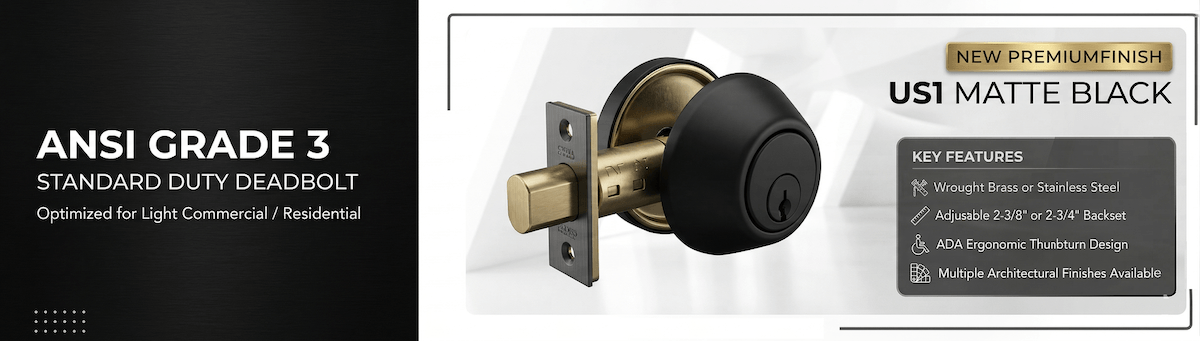
A deadbolt lock is widely considered one of the most effective and common ways to secure an exterior door. Unlike standard spring-latch locks (like those found on a doorknob), a deadbolt cannot be simply "shimmed" or "jimmied" open with a credit card because its bolt must be actively rotated by a key or a thumbturn to extend or retract.
Understanding how deadbolts work, the different types available, and how they are rated will help you choose the right one for your security needs.
How Deadbolts Work
The core of a deadbolt's security is its simple, robust mechanism. A typical deadbolt consists of:
- The Bolt: A thick, solid metal cylinder (usually hardened steel) that extends from the door into a reinforced hole (the strike plate) in the door frame.
- The Cylinder: The part of the lock where you insert the key. It contains the pin tumbler mechanism that must be aligned for the lock to open.
- The Thumbturn: The lever on the interior side of the door that you turn to manually engage or disengage the lock without a key.
- The Strike Plate: The metal plate that is attached to the door frame. This plate reinforces the frame where the bolt sits, making it much harder to kick in the door.
Types of Deadbolt Locks
Deadbolts come in three primary styles, each serving a different function:
1. Single-Cylinder Deadbolt
This is the most common type of deadbolt found in residential homes.
- How it works: It features a keyhole on the exterior of the door and a thumbturn lever on the interior.
- Best for: Standard front, back, or side doors where there are no windows directly adjacent to the lock.
- Advantage: Convenience. You can easily lock or unlock the door from the inside without needing a key.
2. Double-Cylinder Deadbolt
This type of deadbolt offers enhanced security but requires caution regarding fire safety.
- How it works: It requires a key to lock and unlock from both the inside and the outside. It has no thumbturn.
- Best for: Doors with glass panes or windows located right next to the lock. This prevents an intruder from breaking the glass, reaching inside, and simply turning the thumbturn to unlock the door.
- Important Safety Note: Double-cylinder deadbolts can pose a significant safety hazard in an emergency (like a fire), as you would need to locate and use a key to exit your home. Many fire codes prohibit or discourage their use on primary exit doors.
3. Keyless/Electronic Deadbolt
These modern locks are increasingly popular, offering convenience and security through technology.
- How it works: Instead of (or in addition to) a traditional key, these deadbolts are operated by entering a PIN code on a keypad or touchscreen. Many "smart" versions also connect to Wi-Fi, allowing you to control them via a smartphone app.
- Best for: Busy households, rental properties, or anyone seeking keyless entry and the ability to grant temporary access codes to guests or services.
- Advantage: Eliminates the worry of lost or stolen keys and allows you to track who enters and when.
Deadbolt Ratings: Understanding ANSI Grades
To know how strong a deadbolt is, look for its ANSI (American National Standards Institute) grade. ANSI testing simulates various methods of forced entry, measuring the lock's durability and resistance to attack.
- Grade 1 (Best): This is the highest level of residential security. These locks are tested to withstand significantly more force and cycles of use than others. They are ideal for main entry points on homes and are frequently used in commercial settings.
- Grade 2 (Better): A solid mid-range lock. Grade 2 deadbolts offer good security for most residential applications but are not as robust as Grade 1.
- Grade 3 (Good/Basic): The lowest standard for residential deadbolts. These provide basic security and are often used on secondary doors where extreme security is less of a concern.
Key Features to Look For
When purchasing a deadbolt, beyond the ANSI grade, consider these additional security features:
- Hardened Steel Bolt: Ensure the bolt itself is made of hardened steel or features a hardened steel core to resist sawing and cutting attacks.
- Reinforced Strike Plate: The strength of the lock is only as good as the frame it locks into. Look for a strike plate that is heavy-duty and includes extra-long (3-inch) screws to anchor it deep into the wall stud, not just the trim of the door frame.
- Drill-Resistant Features: High-quality cylinders may include hardened steel pins or discs designed to deflect drill bits and prevent the cylinder from being drilled out.
- Key Control (Advanced/High-Security): Some advanced deadbolts offer patented key control, meaning keys cannot be duplicated at a hardware store without specific authorization.
Summary
A well-installed, high-quality deadbolt (ideally Grade 1 or 2) is a fundamental and crucial component of home security. It is simple, effective, and significantly deters break-ins.
0 Responses to "How a Deadbolt Works"